
An open letter from a licensed Tampa Bay contractor
Buying Impact Windows? Don’t Make These 7 Costly Mistakes Before You Sign.
A licensed Tampa Bay contractor on the mistakes that cost homeowners thousands, and how to catch every one before a rep leaves your kitchen table.
Dear Homeowner,
TAMPA, Fla. — If you’ve started shopping for impact windows, you’ve already seen the ads.
Maybe a salesman or two has already sat at your kitchen table.
And somewhere along the way you started wondering: if they can take 40% off, what were they charging before?
Good. Hold on to that question. It’s going to save you money.
Now let me get the uncomfortable part out of the way.
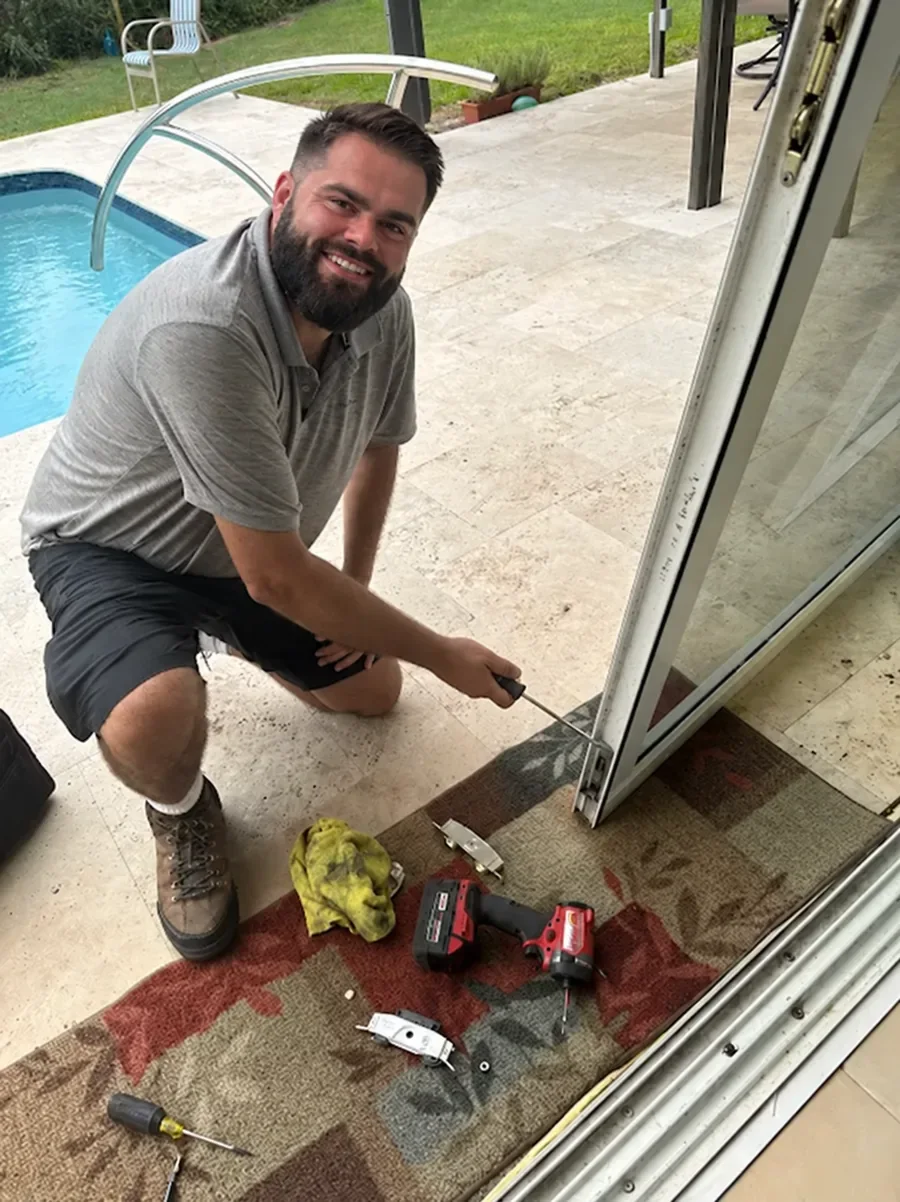
I’m one of those guys. I own a window and door company here in Tampa Bay.
So you’d be right to ask why a contractor would write a letter warning you about contractors.
Here’s my answer. After years at kitchen tables like yours, I’ve seen what goes wrong on window jobs. It’s almost never the window.
It’s something the homeowner didn’t know to ask, at the one moment it mattered.
Before they signed.
Why smart people make expensive mistakes here
The rep who comes to your house has given his presentation hundreds of times. He knows every question you’ll ask, and he knows the answer that keeps you moving toward the signature line.
You’ve done this once. Maybe never.
And almost everything you know about windows came from the companies trying to sell you some.
None of this means you’re careless. The odds favor whoever has the script.
Here are the seven mistakes I see most, roughly in the order they cost people money.
Want all seven on one checklist? They’re in the kit, on your phone or printed in large type.
Get the Kit — $27The 7 Costly Mistakes
1. Trusting the discount instead of the price.
“40% off.” “Buy one, get one free.” “$4,000 back.”
A discount is only as good as the price it’s taken from.
One company can quote you $30,000 after a 40% discount. Another can quote you $22,000 for comparable windows and installation with no discount at all.
The first one feels like the deal. The second one is the deal.
And that’s assuming you’re comparing the same products and the same work. Most quotes aren’t written so you can tell.
What to do: Ignore the percentage. Line up the brand, series, glass package, number of openings and installation work. Then compare the out-the-door total and the cost per opening.
Want to compare your quotes the right way? The kit lines them up side by side, with the out-the-door total and cost per opening.
Get the Kit — $272. Counting on electric and insurance savings that never show up.
“You’ll save 40% on electric and 40% on insurance.”
If you’re using savings like that to justify the payment, this one can hurt.
On electric, your savings depend on the glass you buy, what you’re replacing, your AC, your insulation and how you live. The difference can be a lot smaller than the number you heard at your table.
On insurance, Florida law requires insurers to provide qualifying wind mitigation discounts. But that doesn’t mean every homeowner gets the same discount, or that it applies to the whole premium. It depends on your insurer, what mitigation features your home already has, and how the rates are calculated.
Then there’s the catch. Most insurers treat full opening protection as all or nothing. Replace your windows but leave the garage door, an exterior door or a skylight unprotected, and you can miss the full credit.
You could replace every window in the house and still lose the credit because of the garage door.
You want to know that before you sign, not after.
What to do: Get any savings estimate in writing. Then call your insurance agent before you sign and ask three things: how much of your premium covers hurricanes, how much the opening protection credit would lower it each month, and whether every opening has to be protected to qualify.
3. Signing for “impact windows” without knowing what glass you’re getting.
“Impact window” tells you the window is rated for impact. It doesn’t tell you how it handles heat or noise.
One company’s impact window might be a single pane of laminated glass (monolithic laminated). Another’s might be an insulated glass unit: a laminated pane and a tempered safety pane with a sealed air space between them. Both can be impact rated. They can look the same from the curb. But they can perform very differently on heat, and they don’t cost the same. And Low-E is its own line item on top of that: whether you’re getting it, and where it sits.
Even two insulated units can be built differently. Which pane is laminated and which is tempered. Which one is the sacrificial lite. The interlayer thickness. Where the Low-E coating sits. The U-factor. The solar heat gain coefficient. The Florida Product Approval number.
If you’re buying windows to keep the house cooler and quieter, the glass package is what you’re paying for.
What to do: Never sign a contract that just says “impact windows.” Get the manufacturer, series and exact glass package for every opening in writing.
Now be honest with yourself.
Will you remember “sacrificial lite” and “solar heat gain coefficient” while a rep slides a contract across your table at 8:30 on a weeknight?
Almost no homeowner does. That’s why the rep brings a script.
You should bring one too.
That’s what my Before-You-Buy Kit is for. It lives on your phone, or prints in large type. It gives you the questions to ask every rep, lines your quotes up side by side with the out-the-door total and cost per opening, and tracks what you asked for against what’s actually on paper.
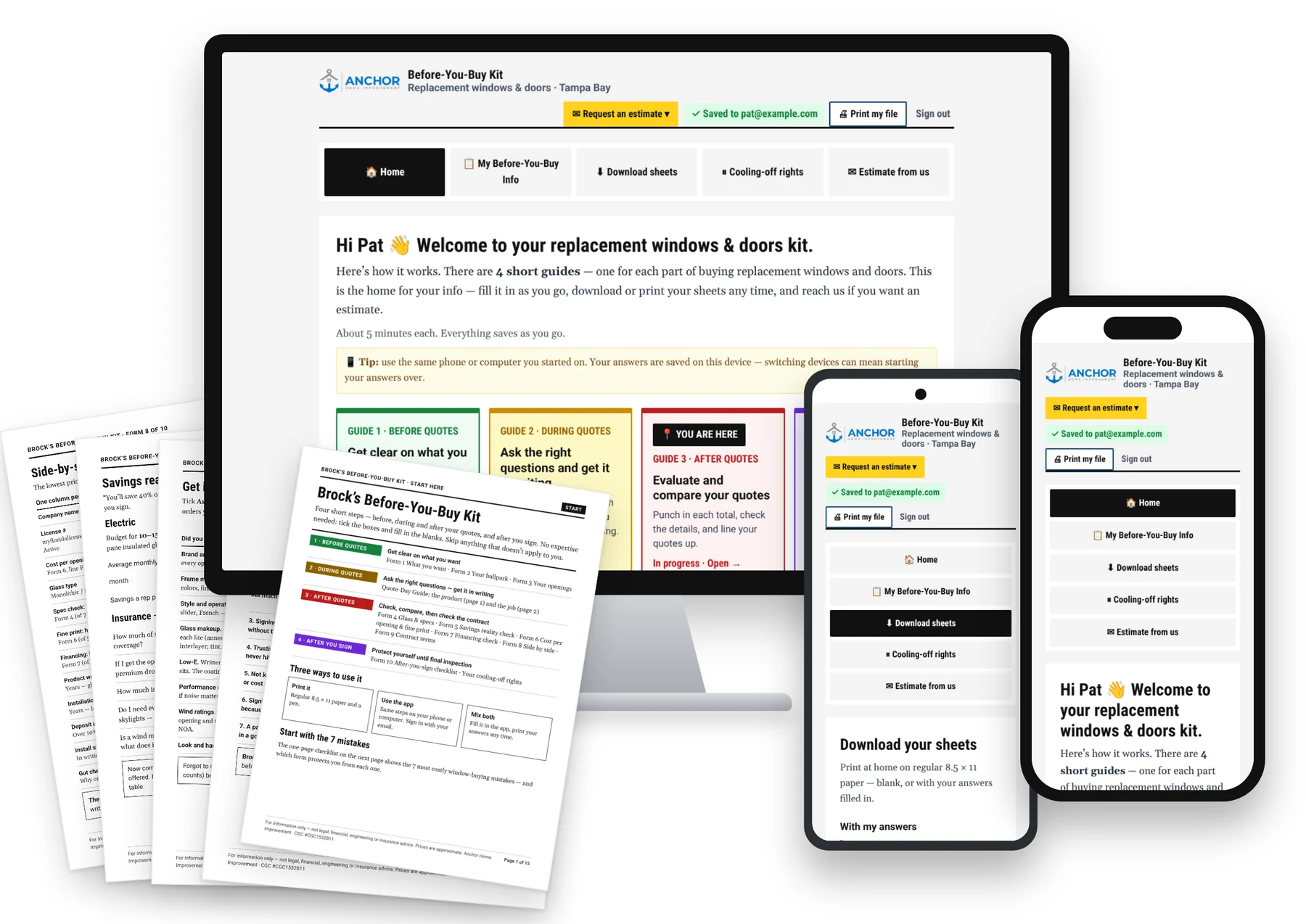
Bring your own script to the kitchen table.
Get My Before-You-Buy Kit — $27Instant access on your phone · 30-day refund
Sold by Anchor Home Improvement of Florida, LLC, Brock’s company. You’re buying directly from us.
4. Trusting a handshake that never makes it into the contract.
The rep agrees to the upgraded glass. The color. The extra door. The stucco work around the frames.
You shake hands.
Then the contract leaves your house.
The rep at your table usually isn’t the one who orders or installs your windows. Your paperwork goes to a back office, then through ordering, permitting, scheduling and the install crew. Every one of those people works from what’s written down. None of them sat at your table.
So installation day comes, and something you agreed to isn’t there. Even if the company agrees to fix it, you could be waiting weeks or months.
What to do: Before you sign, read the contract against everything you discussed: products, colors, glass, installation, finishing work, extras. If it isn’t written down, get it added.
Don’t trust your memory at 8:30 at night. The kit tracks what you asked for against what’s on paper.
Get the Kit — $275. Signing without knowing what they can charge extra for.
You sign for $20,000. The crew pulls your old windows and finds rotted wood bucks, damaged stucco or framing that needs work.
Who pays for that? And how much?
Some contracts leave that wide open.
Then there’s a financing move you never see coming. If you’re approved for more than your quote, some companies see the extra room as an opening. Your $20,000 project becomes $24,000. Then $28,000.
What to do: Push for the installation work, including rotted wood and bucking, to be in the original price. The best contract has no change orders at all, so the number you sign is the number you pay. If they won’t agree to that, get three things in writing: what triggers a change order, that no extra work happens without your written approval, and the most the price can go up.
And keep your financing approval to yourself. Your budget is your number, not theirs.
6. Signing today because “this price is only good today.”
You’ve probably heard it already.
A company’s timeline doesn’t have to be your timeline.
In my experience, more than half the time, if you call back a week or a month later, they’ll still take your business at the same price or very close to it.
What to do: Thank them. Take the quote. Decide on your own schedule. If they want your business, they’ll still want it next week.
Take the quote home. The kit has the extra-cost and contract checklists to run before you call back.
Get the Kit — $277. Taking on a payment you can only afford in a good month.
“It’s only $289 a month.”
That sounds easy at the table. But promo rates end. Deferred interest can come due all at once. And life happens: a car repair, a medical bill, a slow month at work.
Your windows will last 20+ years. The payment has to work in your worst month, not your best one.
What to do: Before you sign, ask yourself how steady your income is, how far it could drop, and whether you have the savings to cover the shortfall. If the honest answer is savings you don’t have, that payment is a problem.
What this looks like at your kitchen table
You’ve got two or three quotes coming. Here’s how the kit takes you through them.
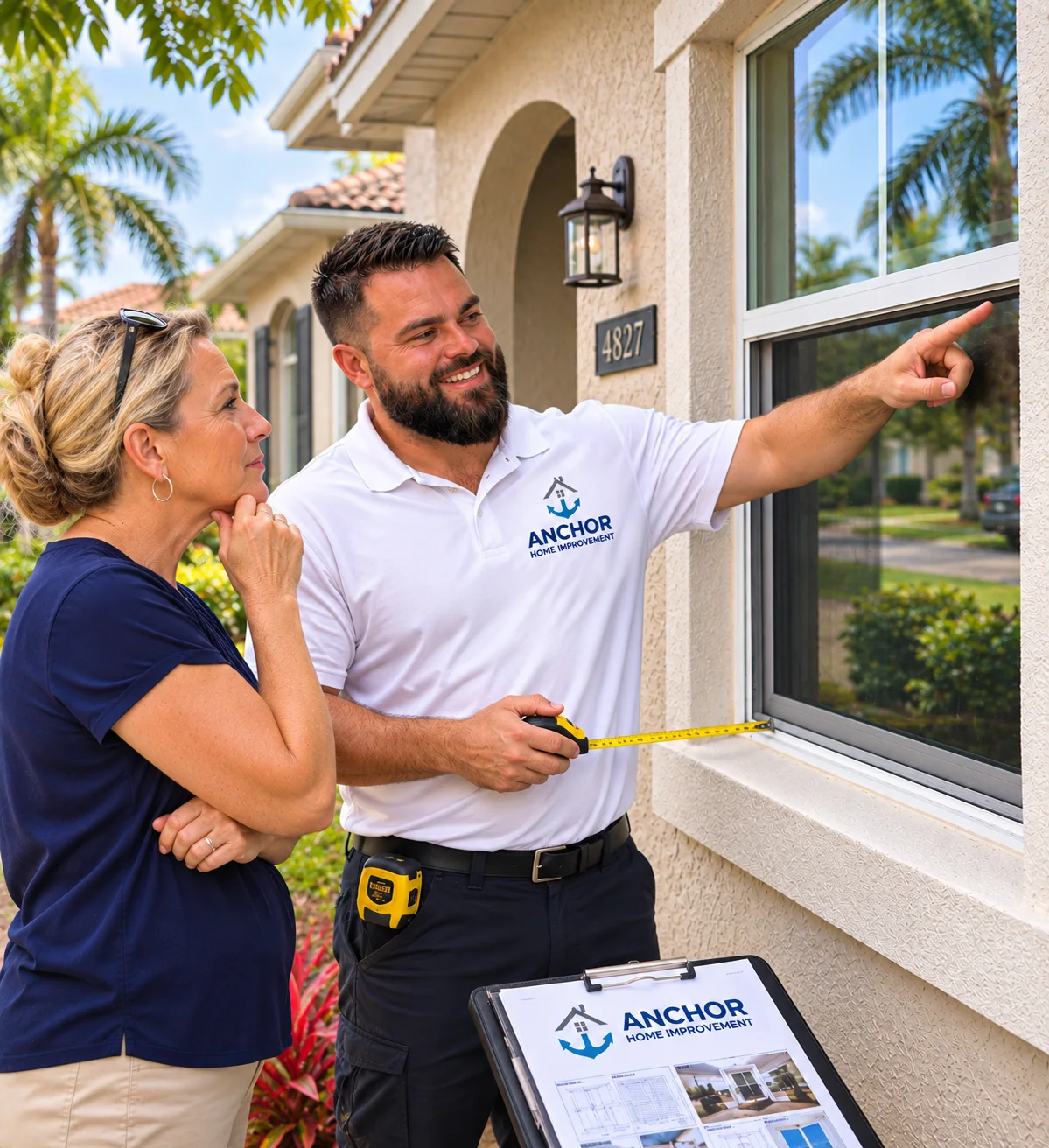
Before the rep arrives, you open the kit on your phone and pull up the questions for every rep. Now you’re asking the things that change the price, instead of the things the presentation was built to answer.
When the quotes come in, the kit lines them up side by side: the out-the-door total, the cost per opening, and what you’re getting for it. A “40% off” quote that still costs $8,000 more gets very easy to spot.
Before you call your insurance agent, you have the exact questions to ask, plus realistic expectations for your power-bill savings.
Before you sign, you run the extra-cost and contract-terms checklists and check what you asked for against what’s on paper. If you’re financing, the financing questions are right there.
If you’ve already signed, the kit covers your cooling-off rights.
Any company’s quote works in it, mine included. You go into the decision knowing exactly what you’re buying.
About the author
Why trust Brock?
Brock Laramee is the founder of Anchor Home Improvement of Florida and a Florida Certified General Contractor (CGC #CGC1532811). From sunup to sundown, he works on windows and doors right here in Tampa Bay.
He’s also written the books on it: consumer guides for Florida homeowners, sold on Amazon. The most important checks from those books are what this kit is built on.
- Licensed Florida Certified General Contractor
- 5× home improvement author on Amazon
- Featured in USA Today
- Featured on FOX 13 Tampa Bay



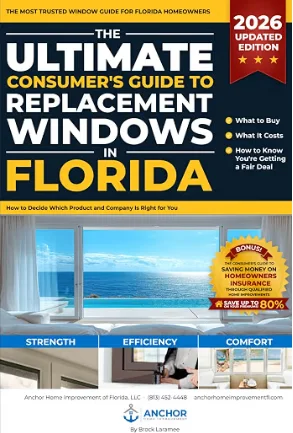
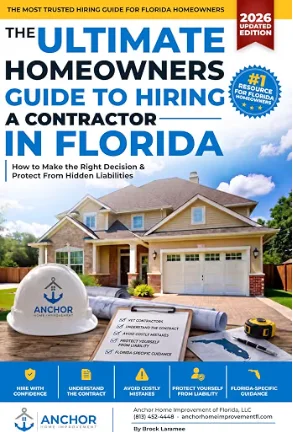
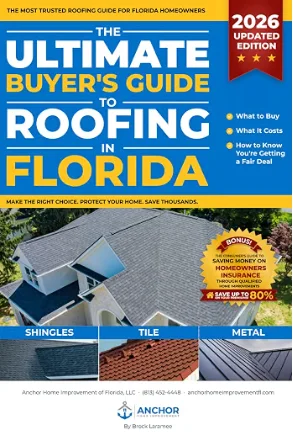
The books are sold separately on Amazon and aren’t part of the $27 kit.
You take no risk at all
Use it for 30 days. If it’s not for you, for any reason, text, email or call and say “refund.” Your money comes back within 24 hours, often faster. No forms, no questions.
And I’ll put $27 of my own on the line. If it’s not for you, I’ll also donate $27 to the charity of your choice and send you the receipt.
So the only way you lose is if you sign before you look.
Who you’re doing business with
This letter ran as a paid advertisement. When you order the kit, you’re buying a product from Anchor Home Improvement of Florida, LLC, Brock’s company, not from a newspaper or publisher. Florida Certified General Contractor CGC #CGC1532811 · Tampa, FL · (813) 796-5782.
Before you spend thousands, spend $27.
Get My Before-You-Buy Kit — $27
Instant access on your phone · 30-day refund
Sold by Anchor Home Improvement of Florida, LLC. You’re buying directly from Brock’s company.
Would you rather have a licensed contractor look at your home in person? Call me for an in-home estimate at (813) 796-5782, Monday to Saturday, 9 AM to 5 PM. Ask for the kit when we meet, and you’ll have it whether you hire me or not.
Good luck with your search, and thank you.
Brock Laramee · Florida Certified General Contractor · 5× home improvement author on Amazon · Featured in USA Today · Featured on FOX 13 Tampa Bay
P.S. If the kit caught one surprise change order, one missed insurance credit, or one glass package that wasn’t what you were told, would that be worth $27?
You have 30 days to decide, and your money back if the answer is no.
Get My Before-You-Buy Kit — $27
Brock Laramee is a Florida Certified General Contractor and founder of Anchor Home Improvement of Florida. He’s a 5× home improvement author on Amazon. Reach him at (813) 796-5782.